
Is Your Business Citable? A Guide to GEO for Southeastern Wisconsin
The Shift in How We Search: From Links to Answers
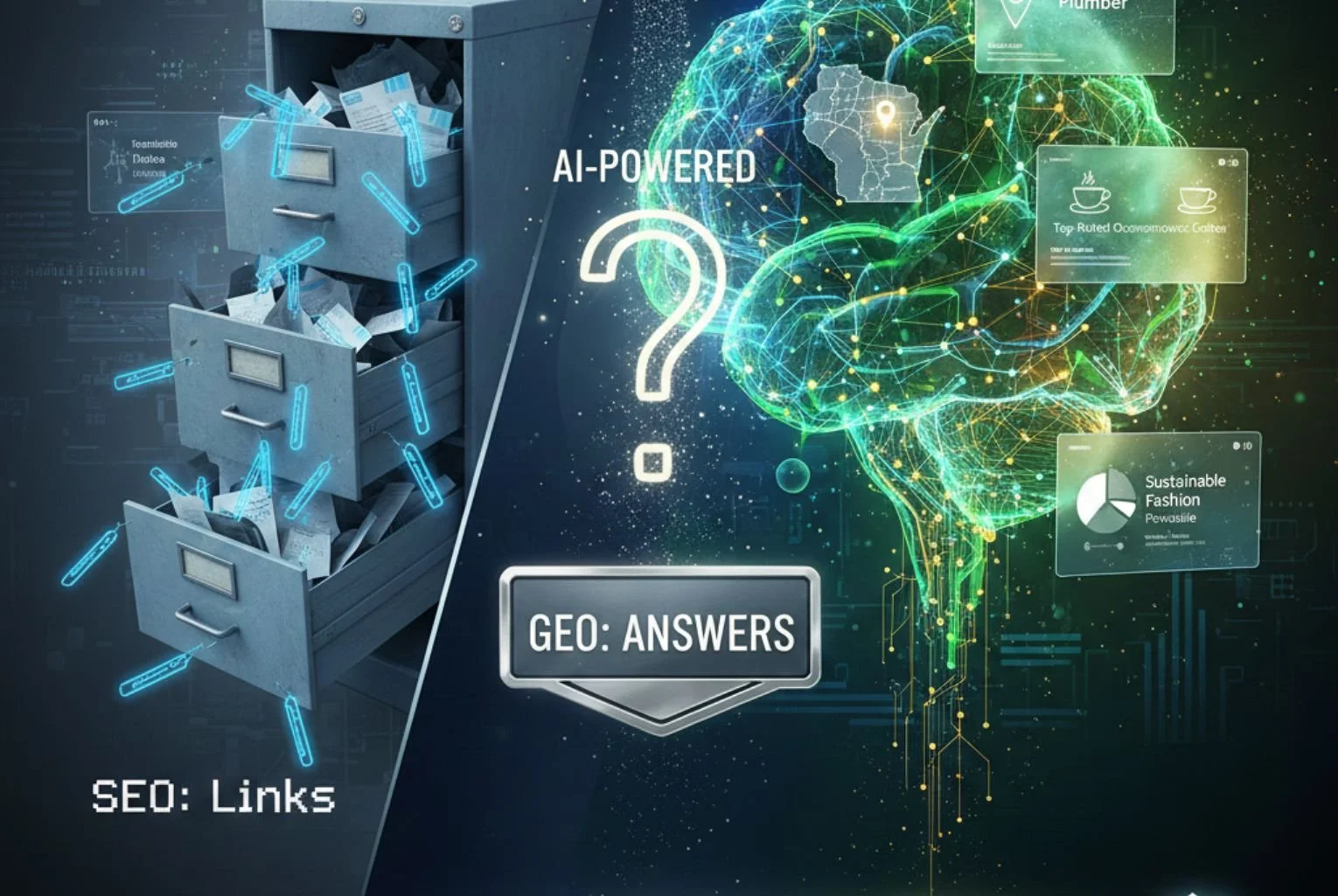
The way residents in southeastern Wisconsin interact with the internet is undergoing a fundamental evolution. For decades, the "Old Search" was a straightforward, if sometimes crowded, digital filing cabinet. You typed a query like "Waukesha plumber" or "best coffee in Oconomowoc" into a search bar, and Google provided an index—a list of blue links. As a business owner, your goal was simple: get your link as close to the top of that list as possible.
But the era of the "list of links" is rapidly fading. We have entered the age of "New Search," powered by AI answer engines that don't just surface information—they make recommendations.
Today, consumers aren't just looking for a website to click on; they are looking for a definitive answer. Instead of browsing a dozen results, they are asking conversational tools, "Who is the most reliable emergency plumber near me right now?" or "Compare the top-rated boutiques in Pewaukee for sustainable fashion." In this new landscape, the AI doesn't just show you a website; it provide a direct response drawn from across the web.
The stakes for local businesses have never been higher. In this new "Answer Economy," it is no longer enough to simply be listed on the web. To thrive, you have to be recommended. If an AI model cannot verify your authority, understand your services, or cite you as a trusted source, your business effectively disappears from the conversation.
This post is a deep dive into this new frontier—and how local businesses can position themselves to remain visible as search continues to evolve.
Defining GEO: The "Citation Economy"
While "SEO" is a household term for most business owners, Generative Engine Optimization (GEO) represents the next evolution of how visibility is earned online. If traditional SEO is about ranking in a list, GEO is about being the primary source of the answer.
Think of it as the "Citation Economy." When an AI engine generates a response to a user's question, it doesn't pull those facts out of thin air. It scans the vast digital landscape for the most credible, clear, and consistent information, then effectively "cites" those sources to construct its answer. GEO is the strategic process of ensuring your business is the one being cited.
For a boutique in Delafield or a contractor in Brookfield, this means moving beyond simple keyword density. AI engines aren't just looking for the words "home remodeling"; they are looking for signals of trust.
They evaluate:
Consistency: Is your business data—from service lists to contact info—identical across every corner of the web?
Credibility: Is your expertise recognized by reputable, third-party platforms and local voices?
Authority: Does your content provide the specific, verifiable depth that allows an AI to answer a user's complex question with total confidence?
The New "Word-of-Mouth" for Lake Country
In southeastern Wisconsin, community trust has always been built on word-of-mouth. GEO is essentially the digital version of that local reputation. When a resident asks their phone for a recommendation, the AI acts as a digital neighbor. If the AI sees your business as a trusted, verifiable fact, you get the recommendation. If it doesn't, you simply aren't part of the conversation.
At Lake Country Digital, we define GEO not as a way to "game" the system, but as a way to align your presence so clearly that AI models recognize you as the definitive local choice. In a world where AI-driven search is becoming the primary way people find services, being citable is the difference between capturing a new customer and being left out entirely.
SEO vs. GEO: A Partnership, Not a Replacement
It is a common misconception that the rise of AI search means traditional SEO is dead. In reality, the two are inseparable; you cannot have a system recommend a local business that doesn't have a solid structural foundation to stand on.
Think of SEO as the foundation and walls of your digital presence. It represents the technical integrity of your site; your page load performance, mobile usability, and secure architecture. GEO is the interpretive layer that allows AI systems to understand and describe your business to others. You can have the most advanced GEO strategy in the world, but if your website is slow, broken, or unreadable to search engines, AI models won't trust your data enough to cite you as a reliable source.
The relationship between the two can be broken down into two distinct, essential roles:
SEO is for Discovery: It ensures that search engines can find, crawl, and index your pages. This ensures your business exists digitally.
GEO is for Comprehension: It ensures that AI engines can accurately understand, trust, and reference your information to answer a user's conversational prompt.
For businesses in the Lake Country area, this means we don't move away from the "basics." We continue to strengthen the foundational signals that search engines and AI systems rely on to verify a business’s legitimacy and reputation. We then layer GEO on top of that foundation. The goal is to ensure your business isn't just discoverable in a sea of links, but is actively referenced when AI systems generate answers for your future customers.
The "Signal" Myth: Why You Can’t Just "Talk" to AI
A common question we hear from business owners is, "Can't I just tell the AI to recommend me?" It’s a logical thought. If you can chat with a generative AI tool, it feels like you should be able to persuade it through a clever "prompt" or by simply asking it to list your business as the best in town.
This is the "Signal" Myth, and falling for it can be a costly DIY trap.
The reality is that AI systems do not take instructions from business owners—they take signals from the entire web. You cannot "prompt" your way into a permanent recommendation any more than you can "prompt" a stranger into believing you’re a world-class chef without showing them a kitchen, a menu, and a line of happy customers.
The Difference Between Chatting and Optimization
When you ask an AI tool a question, it isn't just listening to you; it is cross-referencing its entire model of the world to ensure the information it provides is accurate.
The User’s Prompt asks the question.
The Global Signal determines the answer.
If you try to "talk" an AI into favoring your business, you are only affecting that one specific, temporary conversation. To the rest of the world (and for every other user), you remain invisible. AI visibility is not built in a chat interface; it is built in the ecosystem.
The Lake Country Digital Edge: Managing the Ecosystem
This is where professional stewardship becomes essential. Truly influencing an AI's output requires managing the vast network of signals that these models use to verify the truth. This includes:
Data Consistency: Ensuring your business facts are identical across high-authority platforms that AI engines use as "truth sets."
Entity Validation: Structuring your digital footprint so AI understands your business as a distinct, reputable entity rather than just a string of text.
Reputation Signals: Managing the reviews and mentions across the web that AI models "read" to determine your reliability and trustworthiness.
A simple chat interface cannot influence these signals. It requires a deep, technical coordination of your entire digital presence. At Lake Country Digital, we don't just "talk" to AI; we provide the evidence that allows AI systems to independently conclude that your business is the right answer.
The Lake Country Digital Strategy: Three Pillars of Visibility
Understanding the theory of GEO is one thing; executing it within a competitive local market is another. At Lake Country Digital, we don’t focus on chasing every update to an AI model’s code. Instead, we focus on the foundational qualities these models are designed to reward.
By focusing on outcomes rather than just technical checklists, we ensure your business remains at the center of the AI conversation. Our strategy is built on three essential pillars:
1. Semantic Authority
In the world of generative search, keywords are no longer the primary currency—expertise is. It is not enough to simply mention a service; you must demonstrate a profound understanding of it. We ensure your business’s unique expertise is recognized and captured at the exact moment AI systems look for answers. This means positioning your digital presence so that it doesn't just "match" a search, but provides the depth of explanation that AI engines feel confident referencing.
2. Entity Verification
AI models operate by connecting "entities"—specific, real-world things like people, places, and businesses. If an AI is unsure whether your Oconomowoc business is the same one mentioned in a local directory or a professional profile, it will view you as a "guess" rather than a fact. We work to solidify your business footprint across the southeastern Wisconsin digital landscape, ensuring that AI sees your brand as a verified, unmistakable entity.
3. Contextual Connectivity
An AI engine’s primary job is to interpret intent. If a user asks for a "family-friendly venue in Waukesha," the AI has to determine if your business fits that specific context. We bridge the gap between what your business does and how an AI interprets it. By aligning your digital presence with clear, contextual signals, we ensure that your services are correctly mapped to the specific needs and nuances of the local community.
Through these three pillars, we move your business beyond the "maybe" pile and into the "must-cite" category. We aren't just adjusting meta tags; we are curating a digital reputation that modern, AI-driven systems can trust.
The AI Trust Factor: What Machines Need to Recommend You
While the technical methods behind Generative Engine Optimization are complex, the logic AI models use to determine trust is remarkably straightforward. To the systems powering the next generation of search, trust is not an abstract feeling—it is a series of verifiable requirements.
For a local business to be recommended, it must meet these four high-level criteria:
Consistency: AI models are designed to identify patterns. If your business hours, service areas, or core offerings vary from one platform to another, the AI encounters "friction." To be recommended, you need a unified, consistent story told across the entire digital landscape.
Clarity: AI "hallucination"—where a model makes an incorrect guess—often happens when information is vague or contradictory. Machines need clear, unambiguous information that leaves no room for interpretation. The more precise your digital footprint, the more confident an AI feels referencing you.
Regional Relevance: A national agency might understand the "what" of your business, but they often miss the "where." AI systems look for deep-rooted local signals that prove you aren't just a generic service provider, but a vital part of the southeastern Wisconsin community.
Verifiable Authority: Trust must be earned through evidence. AI models look for proof—in the form of mentions, reputable associations, and community trust signals—that you are indeed the "Go-To" expert in the Oconomowoc/Waukesha area.
By meeting these requirements, you are providing the foundational signals AI systems need to do their job. When an AI can verify your consistency and authority, it stops viewing your business as a possibility and starts treating it as a fact.
Why Local Intuition Outperforms Global Algorithms
There is a final, human element to this technology shift that often gets lost in the talk of algorithms and data sets. While AI is incredibly sophisticated, it lacks intuition. It can define a service, but it doesn't naturally understand the specific "vibe" of downtown Delafield or the seasonal urgency of a Lake Country homeowner preparing for a Wisconsin winter.
A national agency using a generic GEO playbook might get the technical data right, but they often fail to capture the local context that makes a business resonate with its neighbors. At Lake Country Digital, we act as the translator between your local passion and the machine logic of an AI model. We ensure that when an AI summarizes your business, it isn't just accurate—it’s relevant to the actual people living and working in our community.
Conclusion: The Power of AI Memory
We are currently in a unique window of time. AI models are "learning" the world and building their foundational maps of who to trust. This is what we call AI Memory. The businesses that these systems learn and verify first tend to stay recommended the longest. The effort you put into your digital reputation today is not just about this month’s leads; it is an investment that will pay dividends for years to come.
The shift from the "list of links" to the "answer economy" isn't a hurdle—it’s an opportunity for the best local businesses to finally stand out. By moving beyond the blue links and becoming a citable authority, you ensure your business remains at the center of the conversation, no matter how the technology evolves.
Our mission is to ensure that Wisconsin’s most trusted businesses are not just participants in this new era, but leaders of it.
Is your business part of the answer—or just part of the index?
If you’re not confident that an AI could accurately explain what your business does—or recommend you by name—there’s a visibility gap that needs to be addressed.
At Lake Country Digital, we help southeastern Wisconsin businesses understand how they’re being interpreted by modern AI search systems and what it takes to become a trusted, citable authority.
Schedule a consultation to find out where your business stands—and what it will take to lead in the next era of local search.